Erika Lynn Adams
Contact me!
  • Home
  • The Tale Collector's Blog
    • Books, Graphic Novels, and Other Works of Literature
    • Movies, Short Films, and Other Works of Cinema
    • Video Games, Simulations, and Other Interactive Experiences
    • TV Shows, Web Series, and Other Narrative Programs
    • Music, Bands, and Other Creations of Sound
    • Adaptations, Retellings, and Old Tales in New Light
  • Interviews, Readings, and More!
  • News (Updated 11/23/25)
  • Biography

A Shifter in Perspective: Switchers

3/25/2019

0 Comments

 
Picture
Picture
Picture
Picture
Picture
Picture
Picture
Picture
Picture
Picture
Picture
Picture
1994-1999, Ages 10 and Up
Gather round and I’ll tell you the tale of a teen who comes to realize her identity through her secret ability to shape-shift.
(3/18/16)
The memory’s a bit vague, but I think it was around this time in high school that I learned of this story. And while it has nothing to do exactly to this month’s signature holiday, it does take place primarily in Ireland, so I figured: why not discuss it now? It was the second book of the series that I picked up first in the library; and of course, I had to find the first book beforehand so that I could follow along. In retrospect, I believe I found it at a good time in my life. Though I was a bit older than the protagonist at the time of my first reading, the story still resonates with me to this day, not only because of its fantasy elements, but because of the symbolism it offers in relation to both the hardships and adventures of growing up.

Each book is episodic, but they all intertwine in overall plot. Switchers centers on Tess, a young teenager who is what’s called a Switcher, one who has the power to shape-shift into any animal at will. In the first book, she has told no one of her ability up to this point and typically uses it as a brief escape from normal human life. But one day, she is approached by a boy named Kevin, who has been observing Tess for some time and happens to be a Switcher as well. Kevin reveals to Tess that every Switcher will permanently lose their power once they reach the age of fifteen, and whatever form a Switcher is in at such time will remain that Switcher’s form for the rest of their life—and Kevin’s birthday is only days away. Moreover, he insists that she, a fellow Switcher, is the only one who can help him to stop the mysterious increasing cold that is threatening Ireland and the rest of Northern Hemisphere. In Midnight’s Choice, Tess meets another Switcher named Martin, who, rather than facing the pain of reality, decides to flee from it by retreating into the form of a deadly creature that feels no remorse or weakness; Tess is left to face him and his darkness without the aid and companionship of Kevin. And in Wild Blood, Tess, while visiting her uncle and his family in the country, is about to turn fifteen herself and is agonizing over what shape to take for the rest of her life. But when her young cousins suddenly disappear in the woods, Tess must set aside her inner turmoil and find them before both they and her abilities are lost forever.

To begin with, the chemistry between Tess and Kevin evolves beautifully, despite a rough start in their relationship, as they become a foil for one another. A significantly fascinating aspect of Tess’s character is how closed-minded she is at times, not wanting to believe in what hasn’t been proven to her and often afraid to venture out of her comfort zone. But Kevin opens Tess’s eyes to greater possibilities by encouraging her to explore parts of the animal world that she never had before. It’s worth mentioning here that much of the splendor of this tale comes from the exploration of the minds of the animals the main characters become. Thompson gives readers vivid portrayals of the consciousness of numerous creatures, such as rats, owls, and dolphins, describing them as if they were human, but on a level both fundamentally and unattainably diverse. Upon learning that Tess has never been a goat, Kevin is surprised and convinces her to try it; the experience turns out to be much better than she expects:

               “Tess was surprised by some of the things that she was learning. She found that it was a myth that goats would eat anything. On the contrary, her senses of smell and taste were so refined that she could tell in an instant whether a moth had laid eggs on a leaf or a bird dropping had landed there, even a month ago. She would leave anything that was the slightest bit tainted where it was on the tree, and eat carefully around it. She found that she had a rich and rare sense of her own independence. [. . .] [S]tronger than any every other emotion in a goat’s heart is the love of freedom. Even here, amid the luxury of the rich lands where food would never be scarce, her goat soul longed for the high, craggy places of the world, places that are of no use to mankind but are the wild, windy kingdoms of goats.
               [. . .]
               Kevin turned to Tess, and the sly, mischievous glint was in his eye again. Tess knew that for the first time, she was returning it. Together they slipped through the fence as if it wasn’t there and strolled out into the field.” (Pg. 105-106)
 
              [. . .]
 
              Tess and Kevin, communicating by a combination of goat gestures and rat images, were having a ball. Three policemen and a gathering of neighborhood residents were red in the face with exertion and fury. The goats dodged and scrambled, jumped walls, and pushed through hedges. They split up without hesitation when they had to and met up again as soon as they could. They avoided traps with uncanny and infuriating ease.
               A local farmer had been called in to help and he had arrived full of cool confidence with his two best sheepdogs. But ten minutes after he had arrived, the farmer was coaxing the terrified creatures back into his Land Rover and wondering if they would ever work again.
 
               [. . .]
 
[. . .] [The goats] swung at full speed into the yard at the side of the house and veered in through the open door of the woodshed. A few seconds later, Tess and Kevin emerged laughing, their eyes still shining with mischief.” (Switchers: Pg. 110-111)
 
Tess, on the other hand, acts as a link to humanity for Kevin, who has never felt right living among humans; as an animal (especially a rat), he always knows his place, for better or worse, because animals don’t lie or pretend as humans do. Upon meeting Lizzie—an eccentric old woman and former Switcher herself —Kevin quickly butts heads with her, but Tess is able to see that they are more alike than they realize:
 
               “‘That’s teenagers for you,’ Lizzie went on, her voice rising in tone to near hysteria. ‘They hasn’t even started and they’s had enough. They only wants to sit in front of the TV or have a good time for theirselves being jackdaws and puppies and toads. They’s always had enough, even before they’s had what they come for!’
               Kevin wheeled on her, [. . .] ‘And what about stupid old women? Who invites . . . who invite people to visit them and drag them across Dublin and then tell them to mind their manners so they can stand there and abuse them?’
               ‘You hasn’t any manners to mind!’ shouted Lizzie.
               ‘Listen to who’s talking!’ yelled Kevin, and he stormed out. He was halfway up the little path before Tess caught up with him. [. . .]
‘Wait, Kevin,’ she said.
               ‘What for?’
               ‘I want to talk to you for a minute.’
               ‘Talk?’ he said. ‘That’s all people ever do. Talk, talk, talk. They talk so much they get on each other’s nerves and what happens then? They have to bloody well talk about it!’
               ‘Don’t be like that, Kevin.’
               ‘Why not? What’s the point of all that talking, eh? Now you want to talk about that stupid old woman, and we wouldn’t be here in the first place if it weren’t for her talking too much.’
 
             [. . .]
              
‘Don’t you see?’ she said. ‘The old woman is like you. She doesn’t understand people, either. She doesn’t know how to behave.’
               Kevin turned away from her. ‘It just proves my point, doesn’t it?’ he said. ‘It’s a waste of time trying to understand people.’ But Tess knew he was disarmed now.
              
             [. . .]
 
‘Do you know something, Kevin?’ she said.
               ‘What?’
               ‘You care a lot more about people than you think you do.’
               ‘Oh, do I?’ His voice was full of contempt. ‘Why do you think that?’
               ‘Because if you really didn’t care, if you really thought people were so useless, then they couldn’t upset you, could they? Because you’d never expect anything better.’” (Switchers: Pg. 92-94)

With each adventure, Tess grows stronger as a Switcher, but faces ever increasing struggles as a human as well, further emphasized by her inability to choose a final form. It is not only the choice of what creature suits her best that she must consider, or even the thought of disappearing from her parents’ lives with no explanation. It is the fear of regret and lost chances that haunts her, the knowledge that the future is inevitable, and she can’t see herself in it, nor can she see a life that will give her unconditional happiness. But face this reality, she must, like any other growing human being:

            “[Tess] thought of the land again, the fresh green beauty of the woods and the greed of the people who wanted to destroy them in order to line their own pockets. She didn’t want to be an adult in a society like that, where no one cared about anything except money. She envisioned the world as a gray barren place, where nothing lived except human beings and nothing grew except the food they ate. Like a plague on the earth. Like locusts, they destroyed everything before them. Like locusts, they could see no further than their own, immediate greed.
               She wouldn’t join them. Better to be an animal, even a greedy one like a pig or a rat. At least they didn’t pretend to care. People were worse. People were hypocrites. [. . .]
 
               [. . .]
 
               A sudden gust of wind rattled the window hard, and Tess sat up with a start. There was something [that Lizzie] had said. What was it? Tess concentrated and, obligingly, the words came to her.
               ‘Does we believe what we see, or does we see what we believe?’
 
             [. . .]
 
               Tess knew now that the chips were down. She could still cop out, of course. [. . .] But [. . .] it would be an admission that her fear had defeated her. And suddenly she realized that she didn’t need Lizzie to tell her what to do. The truth, plain and simple, was that if anyone had a chance of finding those children it was she. [. . .]
             After tonight her powers would be gone. The events of the day were moving too fast, robbing her of time and space to think, and it looked now as though she wasn’t going to have time to make a considered choice of what to be. But perhaps it didn’t matter. Perhaps it didn’t help to have time to think. Up until now all the thinking in the world hadn’t helped her arrive at a decision.
             [. . .] For the next few hours she still had her Switching powers. If she did not use them while she could, she might spend the rest of her life regretting it.
With a feeling of courage returning, of becoming herself again after a long absence, Tess flung open the window.” (Wild Blood: Pg. 168-171)

Too old to be utterly sheltered anymore, yet too young to be fully understanding of real life, teens are often faced with choices that could potentially alter their way of thinking and their lives in turn, something they may not want to admit is daunting for them. They may feel caught at that important threshold between childhood and adulthood, as once they go forward it may be next to impossible to go back. But this can also be an asset: teens can begin to explore the world and learn to live in it while their minds and hearts are still open enough to embrace its joys and glories that adults may have forgotten or disapproved of. I believe that, through Switchers, Thompson portrays these struggles in a very authentic and poignant manner even as the supernatural is occurring all around.

CREDITS:
Special thanks to KTWH 99.5 Two Harbors Community Radio. All images, audio, and links belong to their respective owners; no copyright infringement is intended.
 
All excerpts are from the novels, Switchers (1999 Hyperion paperback edition) and Wild Blood (2002 Hyperion paperback edition) by Kate Thompson
 
MAIN THEME:
“The Call” – Briand Morrison and Roxann Berglund

https://www.briandmorrison.com/

https://www.facebook.com/BriandMorrisonGuitar/
https://www.youtube.com/user/briandmorrison​
​
EPISODE SONGS:
“Majestic Heart” – The Curellis

https://www.facebook.com/JakeSearlMusic

“Rince” – The Curellis
“Peaceful 5ths” – The Curellis
Download the full 15-minute episode here!

Switchers on Wikipedia

Kate Thompson's Official Website

Switchers on Goodreads

Switchers on Amazon

Switchers at Barnes & Noble

Switchers on eBay

​
^^ Back to Books, Graphic Novels, and Other Works of Literature
0 Comments

The Gift Who Keeps on Giving: The Legend of Holly Claus

3/25/2019

1 Comment

 
Picture
2004, Ages 9 and Up
Gather round and I’ll tell you the tale of the birth and life of the first child of Santa Claus.
(12/18/15)
When it comes to Christmas stories, I’m not afraid to admit that I am a bit old-fashioned. Whether they be the classic TV specials of yesteryear—like the animated Dr. Seuss’ How the Grinch Stole Christmas, Rudolph the Red-Nosed Reindeer, and Frosty the Snowman—or the century-old legends—like ‘Twas the Night Before Christmas, A Christmas Carol, and my personal favorite, The Nutcracker—the tales I love best around the holidays are the ones that not only share the festiveness of the Christmas tradition, but relate that all-powerful mantra, the “true meaning of Christmas”, in ways that are both humbling and universal. Plus, just like good old Charlie Brown, I also have a tendency to feel some depression by today’s commercialism of Christmas.

All of which leads me to this month’s topic: I can’t recall the circumstances of how I found this book, but I’ve always been glad that I did. It’s only about ten years old, and yet its characters, its artwork, and its message, easily make it feel timeless. To celebrate such a joyful occasion, I’d like to talk about one of my all-time favorite Christmas novels.

This story begins with a sort of reversal on a cherished tradition: As the special holiday draws near, children from all over the world write letters to Santa Claus filled with wishes that they would like granted and gifts they would like to receive. But then, one poor little boy named Christopher decides to write a letter of a very different kind to Santa; rather than asking him for some gift, Christopher presents him with a question that no mortal has ever asked: “What do you wish for Christmas, Santa?” And it is this boy’s letter that marks a new beginning for Santa Claus—better known in his realm as Nicholas—for it makes him realize that what he would truly love more than anything . . . is a child of his own. This in turn marks a new beginning for the Land of the Immortals, a place in which “Love Conquers Time,” and over which the wise and kind Nicholas reigns as king, alongside his queen, Viviana. Unfortunately, Herrikhan, an evil sorcerer banished by the universe itself, places a curse upon Holly, the new-born princess, which imprisons her heart in ice, and permanently locks the gates to the Land of the Immortals. So now, with the exception of Nicholas for his annual Christmas delivery, no Immortal can leave the kingdom, nor can the deceased mortals who have earned immortality enter. It ultimately falls on Holly herself to foil Herrikhan’s plans. Traveling to early 20th century New York as a young woman, and upon seeing for herself just how much in need it is of the warmth and compassion the city has long-since lost—especially toward its children, both rich and poor—Holly strives to find a way to bring joy back into the people’s lives and thereby use the strength and courage that joy gives her to defeat Herrikhan and keep the spirit and wonder of Christmas alive for all the people of the world who need it most.

To begin with, both the cover art by Ryan herself and the accompanying illustrations of Laurel Long are just breath-taking, combining elegant realism with whimsical fancy. There is a separate page at the beginning of the book listing the location of every picture within, each one a work of art in and of itself, with such gorgeous pencil-shaded detail that they appear more like portraits of real people than fictional illustrations. One of my favorite pictures is on page 113, depicting Holly’s bedroom. The chandelier and the canopy of her bed are lined with ice crystals and the numerous leaves of silvery trees cover the entire ceiling as if the room is within a forest. Her toys, dolls and wooden soldiers and stuffed animals lay strewn about the floor or bursting out of the toy chest, all but forgotten. With Tundra, her wolf guardian, and Lexy the fox, watching intently from below—Holly stands upon a stack of books so as to reach her enchanted telescope through which she can see far off into the mortal world.

This is one Christmas story that I believe is truly original. Ryan breathes new life into both the legend and the man that is Santa Clause. Once known as St. Nicholas during his mortal life on earth, once that life ended, he was crowned the king of the Land of Forever by the elders of the universe for his selfless acts of generosity. While this title literally and figuratively gives him vast power over both humans and a wide array of magical creatures, he is still someone who would gladly offer a knee for a child to climb onto for a story before bedtime. And speaking of children, just as the legends say, Nicholas always has a special place in his heart for the young as, not only are they and their antics just so adorable, but their faith in dreams and magic has a power all its own for which he has the utmost respect and love:

            “‘Of course, [Molly] did throw that doll down the well, You Highness,’ said a calm voice from the corner.
               Nicholas glanced over to the speaker, a pure white wolf who lay, apparently asleep, on the thick, soft rug. ‘Of course she did,’ he agreed. ‘Banged her on the head first and then tossed her in.’
               ‘And the funeral, sire. She made the neighbor children pay to come.’
               Nicholas laughed harder. ‘Did she? That’s my little Molly! Bless her soul.’ He thought for a moment. ‘It sounds as though we’ve lost Stella, though, Terra.’
               ‘Yes, Your Majesty,’ said the wolf quietly. She knew that it always hurt him when they stop believing.
               ‘But Molly, now; she’ll be with us a long time,’ said Nicholas brightly. ‘Maybe she’s one of the ones who will last forever.’ He reached for the next letter, but his mind lingered on Molly. How he would mourn the day she stopped writing to him. But no, he scolded himself, he would have the pleasure of watching her story unfold. And besides, that’s how it had to be. [. . .]
               [. . .] Nicholas, burrowed in his chair, read letter after letter. Many of them made him smile; a few made him laugh out loud; but each one was precious to him, for it told him the story of a child he knew and loved. Kostya was trying to be considerate of others and a new butterfly net would help; Astrid was certain she could be good if only she had a set of paints; Santiago admitted that he had behaved terribly about the cat, but regretted it and wanted some soldiers, please; Elena and Concetta were bent on becoming pirates, so they needed some books on the subject; Silas planned to go west as soon as possible and would require a small wagon. On and on it went, thousands of children, each alive to possibility and dreams. (Pg. 16-17)

Holly, as she grows up, proves to be just as kind and noble as her legendary father, striving to help all she meets however she can, from teaching a cockeyed reindeer to fly, to using her newfound ability to form perfect dolls with only her hands in almost no time flat. But she finds herself hindered by Herrikhan’s curse, not only by the very nature of it, as she must always stay in cold areas to keep her heart alive, but by the other repercussions it brings on, such as many people in the kingdom being afraid of Holly, believing that her presence will bring another visit from Herrikhan. This, in fact, exemplifies one of the main messages of the story: how fear alone is capable of crippling, if not destroying, dreams and life. When she, at long last, makes it to New York City, she finds population divided by age as well as class, and, consequently, by distress and confusion. For instance, Holly invites some rich but timid children to play with her in the snow before being stopped by their stern governess:

“‘[Miss Bellows’] sharp eyes took in [Holly’s] disheveled appearance. [. . .] “And under whose authority have you invited the children in my care to go skating with ruffians?’
               ‘Under my own,’ said Holly steadily.
               ‘I’m afraid, Miss Claus, or whoever you are, that is insufficient. The children of Dr. Louis Braunfels do not proceed in such a disordered fashion. And they most certainly do not skate in the kind of low company you obviously find attractive.’
               ‘What do you mean by ‘low company’?’ asked Holly, honestly curious.
               Miss Bellows turned redder than ever. ‘The common, squalid characters who frequent the lake, that’s what I mean by low company, Miss Claus.’
               ‘Ah,’ said Holly, staring at Miss Bellows’s face. ‘That’s what you mean,’ she repeated absently.
               ‘And now I bid you good day!’ snapped Miss Bellows.
               Holly tilted her head questioningly. She seemed to be thinking about something far different than the topic at hand. She looked into Miss Bellows’s small blue eyes for a moment, until the governess dropped her gaze. The children watched, openmouthed, for Miss Bellows appeared, suddenly, not to know what to do. She was twisting her handkerchief in the strangest fashion.
               ‘What are you afraid of?’ said Holly softly.
               ‘The children,’ gulped Miss Bellows.
               ‘Why?” asked Holly.
               ‘Because they hate me.’
               ‘No. They are frightened of you, but they don’t hate you. They will love you if you love them.’ Holly looked intently into Miss Bellows’s eyes and then transferred Evelyn’s hand from her own to the governess’s.
Miss Bellows swallowed visibly. Evelyn, staring at her governess’s fearful face, suddenly felt a rush of compassion for Miss Bellows.” (Pg. 262-263)

But there is no way my words alone could ever do this Christmas masterpiece justice. Ryan does not simply give readers a little village in the middle of the North Pole, teaming with elves and reindeer. Here is a place that only five living mortals have witnessed—and then only the fringes of it—encircled in magical jewel-like glaciers and where silver snowflakes swirl in the air like ballet dancers, where the spirit of Christmas is a way of life, as far away and yet not so far away as a dream, but every bit as enchanting. In this way, though Holly Claus is primarily Christmas-themed, it has something for every lover of fantasy. Holly serves as the bridge that reconnects humanity with the love of childhood and the power of faith. In fact (though I don’t know if this practice is still in effect today), this book and its heroine have become so popular that back in 2005, the United States Post Office officially recognized Holly’s home as an address—complete with its own zip code of 90209-1225—to which children can write letters to Holly and the Claus family; and Ryan actually answers those letters as Holly herself! Ryan combines pure wonder with rich detail and compelling characters and narrative to create a delight for both the eye and the imagination in honor of the most joyous of holidays.

CREDITS:
Special thanks to KTWH 99.5 Two Harbors Community Radio. All images, audio, and links belong to their respective owners; no copyright infringement is intended.

All book excerpts are from The Legend of Holly Claus by Brittney Ryan (2004 paperback edition; published by HarperTrophy).

MAIN THEME:
“The Call” – Briand Morrison and Roxann Berglund

https://www.briandmorrison.com/

https://www.facebook.com/BriandMorrisonGuitar/
https://www.youtube.com/user/briandmorrison
EPISODE SONGS:
​“Saturnalia Peace” - The Curellis

https://www.facebook.com/JakeSearlMusic

“So Softly Falls the Snow” - Thomas Wayne King

https://www.wisconsinacademy.org/contributor/thomas-wayne-king

“Winter Magic” - Thomas Wayne King
Download the full 15-minute episode here!
​
Brittney Ryan on Wikipedia

Brittney Ryan's Facebook Page

The Legend of Holly Claus on Goodreads

The Legend of Holly Claus on Common Sense Media

The Legend of Holly Claus at Barnes & Noble

The Legend of Holly Claus on Amazon

The Legend of Holly Claus on eBay

​
^^ Back to Books, Graphic Novels, and Other Works of Literature
1 Comment

Inspired By True Stories: A Monster Calls

3/25/2019

0 Comments

 
Picture
2011, Ages 12 and Up
Gather round and I'll tell you the tale of a monster who uses stories to help a boy cope during a time of great pain and sorrow.
(8/21/15)
It is very rare that a book moves me to tears, but when it does, it really does. Only four novels have ever had this sort of impact on me: Paulo Coelho’s The Alchemist, from sheer joy; J.K. Rowling’s Harry Potter and the Half-Blood Prince, from the pain of loss, for what are now probably obvious reasons; and Kate DiCamillo’s The Miraculous Journey of Edward Tulane, for a bit of both sadness and hope. The fourth I’m going to discuss here, for its evocative honesty in the midst of relentless anguish. It was not only the story that is so heart-rending, but the history of its creation.

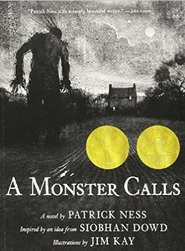
A Monster Calls is the story of Conor, a 13-year-old boy living in present-day Britain. Ever since his mother was diagnosed with a terrible illness—implied to be cancer due to the descriptions of hair loss and the treatments that sap all her energy—Conor has been suffering from constant nightmares. Or rather, a single nightmare over and over again, involving a black creature with long tenticles glowing eyes that threaten to paralyze and suffocate him. One night, to Conor’s great surprise, he wakes up to find another kind of monster, this one very real and very different, seeming to be made up of branches that “[twist] around one another, always creaking, always groaning”, and “thin, needle-like leaves weaving together to make a green, furry skin that [moves] and [breathes] as there were muscles and lungs underneath” (p. 5). This monster claims to be the very spirit of the earth, most often taking the form of a yew tree. More to the point, it claims that it was summoned by Conor himself, yet the latter can’t recall such a thing. The reason for its coming, says the monster, is to heal Conor (from what Conor has no idea); but in order to do so, the monster must tell Conor three stories from its past travels across the lands of the world, after which Conor tell the monster a fourth in turn: the truth that he has been denying and that he would rather die than admit.

Though this novel was written by Chaos Walking trilogy author Patrick Ness, the idea for it was conceived by Siobhan Dowd, writing activist and author of four young adult novels. She was unfortunately diagnosed with severe terminal breast cancer and, passed away this day in 2007 at the age of 47 before she could further develop the idea. Ness was then contacted by Dowd’s Walker Books editor, Denise Johnstone-Burt (who had previously worked with both writers, though the two never met personally) to put Dowd’s story to paper. To this day, A Monster Calls is the only book whose creators have been awarded both the Carnegie and Kate Greenaway Medals, Ness for literature and Jim Kay for illustration, respectively.

It would be very easy for one seeing this book for the first time to believe it is a horror or suspense story; that’s what I believed at first, and not only because of the title. According to the biography at the back of the book, Kay “used everything from beetles to breadboards to create interesting marks and textures.” Indeed, many of the pictures have a very harsh, scratchy look to them, especially the monster with its thousands of dense clusters of branches and twigs, making it appear all the more wild and imposing, just like nature and the land it embodies and represents. The sky and other environments throughout often appear blotted or streaked, like either a terrible storm is brewing and just waiting to unleash its wrath, or the sky itself is as miserable as the characters in the story and just as unable or unwilling to shed its “tears.” In many scenes, Conor is often depicted as a white silhouette against almost complete blackness, whether it be the monster, his nightmare, or even sometimes the real world, symbolizing to me how the worst aspects of Connor’s reality continually threaten to overwhelm what parts of himself remain and swallow him up. No human faces are ever visually depicted, but on the rare occasion that eyes are shown, like those of the monster or some animal, they are always white with no pupils, either cold and unpredictable or dull and inert.

While this story certainly is frightening to an extent, it is less so in the sense of devilish horror than of pure despair. From Connor’s point of view, the reader gets the sense that he feels he’s the only one who has any faith that his mother will eventually recover, fueling the seemingly justified bitterness that Conor harbors within his heart. While he believes and wishes for his mother’s life more than anything, it is as though the rest of his family is simply giving up and moving on with their own lives while wanting Conor to “be brave” and “talk about what’s going to happen”.

His divorced father is remarried with another child and living in America, which in itself is painful, but there are also some particularly excruciating moments, like when his new “American” habits present themselves, namely the annoying tendency to call Conor childish names like “Champ” and Sport”:

          “‘How you hanging in there, champ?’ his father asked him while they waited for the waitress to bring them their pizzas.
          ‘Champ?’ Conor asked, raising a skeptical eyebrow.
          ‘Sorry,’ his father said, smiling bashfully. ‘America is almost a whole different language . . . Your sister’s doing well. Almost walking.’
          ‘Half-sister,’ Conor said.
          ‘I can’t wait for you to meet her,’ his father said. ‘We’ll have to arrange for a visit soon. Maybe even this Christmas. Would you like that?’ . . .
          Conor ran a hand along the edge of the table. ‘So it’d just be a visit then?’
          ‘What do you mean?’ his father said, sounding surprised. ‘A visit as opposed to . . .’ He trailed off, and Conor knew he’d worked out what he meant. ‘Conor—’
          But Conor suddenly didn’t want him to finish.” (Pg. 86 – 88)

Connor’s grandmother is unnaturally modern, businesslike and independent, treating Conor less like a grandson than just a problem to be dealt with like anything else on a daily basis:

          “Conor’s grandma wasn’t like other grandmas. He’d met Lily’s grandma loads of times, and she was how grandmas were supposed to be: crinkly and smily, with white hair and the whole lot. She cooked meals where she made three separate eternally boiled vegetable portions for everybody and would giggle in the corner at Christmas with a small glass of sherry and a paper crown on her head.
          Conor’s grandma wore tailored pantsuits, dyed her hair to keep out the gray, and said things that made no sense at all, like “Sixty is the new fifty” or “Classic cars need the most expensive polish.” What did that even mean? She emailed birthday cards, would argue with waiters over wine, and still had a job. Her house was even worse, filled with expensive old things you could never touch, like a clock she wouldn’t even let the cleaning lady dust. Which was another thing. What kind of Grandma had a cleaning lady?
          ‘Two sugars, no milk,’ she called from the sitting room as Conor made the tea. As if he didn’t know that from the last three thousand times she visited.” (Pg. 39)

School is even worse as everyone is aware of his mother’s illness and treats Conor differently: his classmates ignore and avoid him Harry and his gang bully him, and his teachers feel patronizing even when trying to be sympathetic. And Lily tries to be a good friend to Connor, but the intention feels hollow since it was because she had told one person of his mother that now everyone knows, a transgression for which he feels he could never forgive her.

Connor is not at all fearful of the monster at first and highly skeptical of its purpose behind its storytelling. But the monster is quick to tell him otherwise:

          “Conor blinked. Then blinked again. ‘You’re going to tell me stories?’
          Indeed, the monster said.
         ‘Well—’ Conor looked around in disbelief. ‘How is that a nightmare?’
          Stories are the wildest things of all, the monster rumbled. Stories chase and bite and hunt.” (Pg. 35)

While the monster’s stories may have simple fairy-tale like beginnings, the characters within, their actions and justifications, prove to be far more complicated than Conor expected—not unlike himself, as the monster ultimately teaches him through pain, love, and personal reflection. In spite of all the apparent lifelessness that permeates this book, life itself is perhaps its most powerful theme. Not only the kind that dictates the natural world but the kind that defines and is defined by humanity as a whole, how we actually live as opposed to how we merely think:

          “You were merely wishing for the end of pain, the monster said. Your own pain . . . It is the most human wish of all.
          ‘I didn’t mean it,’ Conor said.
          You did, the monster said, but you also did not.
          Conor sniffed and looked up to its face, which was as big as a wall in front of him. ‘How can both be true?’ . . .
          The answer is that it does not matter what you think, the monster said, because your mind will contradict itself a hundred times each day . . . Your mind will believe comforting lies while also knowing the painful truths that make those lies necessary. And your mind will punish you for believing both.
          ‘But how do you fight it?’ Conor asked, his voice rough. ‘How do you fight all the different stuff inside?’
          By speaking the truth, the monster said.’” (Pg. 191)

I have not had the pleasure of reading any works from Dowd or Ness, but I can definitely see how they both came to be so beloved in the literary world. I believe I can honestly say that Ness did Dowd and her final idea justice with this hauntingly beautiful tale. This will likely resonate most with those who have had to suffer the emotionally raw and complex pain of losing a loved one, especially when that loss is prolonged but ultimately inevitable.

CREDITS:
Special thanks to KTWH 99.5 Two Harbors Community Radio. All images, audio, and links belong to their respective owners; no copyright infringement is intended.

All book excerpts are from A Monster Calls by Patrick Ness (2013 first U.S. paperback edition; published by Candlewick Press).

MAIN THEME:
“The Call” – Briand Morrison and Roxann Berglund

https://www.briandmorrison.com/

https://www.facebook.com/BriandMorrisonGuitar/
https://www.youtube.com/user/briandmorrison
EPISODE SONGS:
“Tadeusz’s Theme” - Paul Gutmann

https://www.facebook.com/paul.gutmann.77

“Desesperación” - The Curellis

https://www.facebook.com/JakeSearlMusic

“My Strength You Are…Variations and Improvisations on an Eternal Theme” - Thomas Wayne King

https://www.wisconsinacademy.org/contributor/thomas-wayne-king

Download the full 15-minute episode here!

A Monster Calls on Wikipedia

Siobhan Dowd on Wikipedia

The Siobhan Dowd Trust

Patrick Ness on Wikipedia

Patrick Ness's Official Website

Jim Kay's Official Website

A Monster Calls on Common Sense Media

A Monster Calls on Amazon

A Monster Calls ​on Barnes & Noble

A Monster Calls ​on eBay

​​^^ Back to Books, Graphic Novels, and Other Works of Literature
0 Comments
Forward>>

    Books, Graphic Novels, and Other Works of Literature

    For those fond of the written word as well as illustrative art.

    RSS Feed

    Movies, Short Films, and Other Works of Cinema

    Video Games, Simulations, and Other Interactive Experiences

    TV Shows, Web Series, and Other Narrative Programs

    Music, Bands, and Other Creations of Sound

    Adaptations, Retellngs, and Old Tales in New Light

    Chronicles, Histories, and Anecdotes
Proudly powered by Weebly